Removing zinc coating from galvanized steel before welding helps expose clean base metal, reduce zinc entering the weld pool, and limit the amount of zinc oxide fume produced at the joint. For most small jobs, controlled grinding is the practical first choice. Abrasive blasting works better for larger areas, while vinegar may help with small removable parts.
Welding on galvanized steel without proper preparation can create hazardous fumes, excess spatter, and weld porosity. Learning how to remove zinc coating from galvanized steel is therefore part of both joint preparation and exposure control.
The zinc layer protects steel from corrosion, but heat from MIG, TIG, stick welding, brazing, or thermal cutting can melt and vaporize it. The vapor reacts with oxygen and forms fine zinc oxide particles that must be kept out of your breathing zone.
Quick Answer
Remove zinc from the full weld and heat-affected area with controlled grinding or abrasive blasting. Use vinegar only for suitable small removable parts. Capture zinc dust and welding fume at the source, never burn the coating off with a torch, and restore the required corrosion protection after the weld passes inspection.
Key Takeaways
- Grinding is normally the most practical way to clear a local weld zone.
- Abrasive blasting is better suited to frames, beams, recessed surfaces, and batches of parts.
- Vinegar can strip small removable parts, but reaction time varies and hydrogen may be released.
- Do not use a torch to burn zinc away or use strong acids as a casual home method.
- Ventilation, local exhaust, and any respirator must be selected for the actual exposure.
- After welding, inspect the joint and repair the damaged corrosion protection to the project specification.
At a Glance
| Time Required | Often 15–60 minutes for a small grinding job; several hours or longer for a vinegar soak; large blasting jobs vary by setup |
| Difficulty | Moderate for local mechanical removal; professional control required for strong acids, confined spaces, and code-regulated work |
| Tools Needed | Angle grinder and rated flap disc, extraction or HEPA vacuum, eye and hearing protection, gloves, marking tool, inspection light, and welding PPE |
| Cost | Low when suitable tools and extraction are already available; higher for blasting, respiratory protection, testing, or professional service |

Image credit: American Galvanizers Association.
Warning: Zinc removal does not make welding fume harmless. The base metal, filler, paint, oil, plating, and previous repairs may introduce other hazardous substances. Do not weld unknown coated metal, work in a confined space, or perform code-regulated repairs without a documented hazard assessment and qualified procedure.
Why Remove Zinc Coating Before Welding Galvanized Steel?
Galvanized steel uses zinc as a sacrificial coating, which means the zinc corrodes before the underlying steel. According to PubChem’s zinc data, zinc melts at about 787°F or 419.5°C. Steel melts at a much higher temperature, so zinc near a welding arc can melt and vaporize before the base metal forms a stable weld pool.
Zinc melts at about 787°F (419.5°C), far below the temperatures reached in arc welding. That difference is why galvanized coating can become fume and interfere with the molten weld.
Health Risks of Welding Galvanized Steel
Heating zinc-coated steel can expose you to zinc oxide fume. The NIOSH Pocket Guide for zinc oxide lists metal fume fever symptoms such as chills, muscle aches, nausea, fever, dry throat, cough, weakness, headache, and a metallic taste.
Symptoms may begin after you leave the work area. If you feel ill, stop work and move to fresh air. Seek urgent medical help for breathing difficulty, chest pain, confusion, fainting, blue lips, severe weakness, or worsening symptoms. Do not return to the exposure until the cause and controls have been reviewed.
OSHA’s welding-fume guidance explains that working outdoors does not automatically provide adequate ventilation. Whenever possible, local exhaust should capture the plume close to the arc before it reaches your face or spreads through the work area.
Note: Drinking milk does not prevent zinc oxide exposure or replace ventilation, extraction, safe work practices, or properly selected respiratory protection.
How Zinc Affects Weld Quality and Strength
Residual zinc can contribute to an unstable arc, excess spatter, porosity, poor bead appearance, and incomplete fusion. Zinc vapor generated beneath or beside the molten pool must escape, and trapped gas can leave internal or surface voids.
The severity depends on coating thickness, joint design, welding process, heat input, position, travel speed, and access for vapor to escape. Thin electroplated zinc and thick hot-dip galvanizing do not behave identically.
Removing the coating from the full heated joint area exposes cleaner base metal and can reduce rework. It does not guarantee a sound joint by itself. Material identification, fit-up, filler metal, procedure qualification, heat input, operator skill, and inspection still determine whether the weld is acceptable.
Before You Start: Identify the Coating and the Job Requirements
Do not assume that every silver or gray coating is ordinary zinc. Steel may also carry zinc-rich primer, zinc-nickel plating, cadmium plating, lead-containing paint, chromate conversion coating, or an unidentified industrial finish. Ask for the material specification, coating certificate, safety data sheet, or manufacturer information before grinding or heating unknown material.
Also confirm whether the part is noncritical or subject to a welding code, engineering drawing, manufacturer repair procedure, or inspection requirement. Structural members, trailer frames, vehicle safety parts, pressure-containing parts, lifting equipment, pipelines, and high-strength fasteners should not be treated as casual practice pieces.
When to Stop and Use a Professional Shop
- When the coating or base metal cannot be positively identified
- When the part is structural, pressure-containing, load-bearing, or safety-critical
- When the work area is confined or effective fume extraction is unavailable
- When strong-acid stripping appears necessary
- When abrasive blasting cannot be contained safely
- When the project requires a qualified welding procedure or certified welder
- When removing coating could alter the fit, strength, or approval of a fastener
Set Up the Work Area
Separate coating removal, chemical stripping, and hot work into controlled areas. Remove combustible materials, protect nearby wiring and equipment, and provide suitable fire precautions. Keep sparks away from vinegar baths, acid areas, fuel, solvent, and containers that may hold flammable gas.
For grinding, install the grinder guard and side handle. Use only a disc with a speed rating at least as high as the grinder’s no-load speed. Inspect the disc for damage, secure the workpiece, and arrange extraction before starting.
For workplace respirator use, follow the OSHA Respiratory Protection standard. Required tight-fitting respirators need proper selection, medical evaluation, fit testing, training, and seal checks. A particulate filter does not protect against every gas or vapor.
Mechanical Methods to Remove Zinc Coating from Steel
Mechanical removal is usually the most practical choice for local weld preparation because it avoids handling strong liquid acids. Grinding and blasting still create zinc-containing dust, so they require containment, extraction, eye protection, and respiratory controls selected for the exposure.
Products Worth Considering
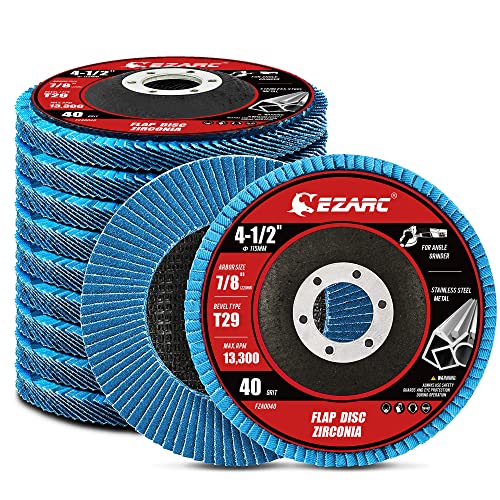
【Great Performance】EZARC flap sanding discs are made of hard zirconia material which lasts longer than standard aluminum oxide abrasive material, built for a more robust and economical grinding wheel

Package Include 24 pcs grinding wheels 4 1/2 inch grit 40 60 80 120,6 of each

STRONGEST FIBER BACKING THAN OTHER PRODUCTS:4 1/2 grinding wheels made for TOP-LEVEL Hard zirconia.Good material for griding wheel. This Flap Disc is constructed of industrial grade high density premium zirconia material, increased durability than standard flap discs, built for a more robust and economical grinding wheel
Grinding Zinc Coating from the Weld Zone
Use an angle grinder with a suitable flap disc to expose clean steel throughout the area that the weld and nearby heat will affect. A 4.5-inch grinder is common for small jobs. A coarse disc such as 36 grit can cut quickly, but a less aggressive grit may give better control on thin sheet.
Mark the joint before grinding. Clear the coating from both accessible sides when both sides will be heated. Some fabrication procedures specify a clearance beyond the weld toe, but there is no universal one- or two-inch rule. The required width depends on coating thickness, joint design, heat input, material thickness, and the approved procedure.
Hold the disc at the manufacturer’s recommended working angle. Many flap discs work at a shallow angle near 15 degrees, but the product instructions control. Use short passes and light pressure. Let the abrasive cut instead of forcing it into the steel.
Stop when continuous bare steel is visible across the preparation area. Check edges, corners, the back of the joint, holes, and recesses. A wire cup brush may help in irregular areas, but it can polish thin coating without proving that all zinc is gone.
Pro Tip: Mark the removal boundary with a paint marker, grind to the line, then inspect under a bright light from two angles. This makes missed strips around edges and corners easier to see.
Place local vacuum extraction close enough to capture dust without interfering with the tool. Clean residue with a HEPA vacuum or another controlled method. Do not use compressed air, a leaf blower, or dry sweeping to spread zinc-containing dust through the shop.
Avoid overgrinding. Deep scratches, thinned edges, gouges, and rounded joint faces can reduce remaining section thickness and make fit-up harder. On critical work, confirm dimensions and remaining thickness before welding.
Why You Should Not Burn Off Zinc with a Torch
Do not use an oxy-fuel torch as a routine zinc-removal method. Heating zinc until it melts, oxidizes, or vaporizes creates the same airborne contaminant that surface preparation is intended to reduce.
The old instruction to heat galvanized steel until it becomes “dull red” is also unreliable. Visible color depends on temperature, lighting, surface condition, and the observer. Heating until a color appears gives no controlled measure of zinc removal and can overheat thin material.
A torch also adds fire, distortion, scale, and hot-work hazards. An engineered industrial thermal-removal process needs trained operators, local exhaust, exposure monitoring where required, fire controls, and a documented procedure. Standing outdoors or upwind is not a substitute.
Drinking milk before or after the work does not neutralize inhaled zinc oxide. If you become ill after heating galvanized material, stop the exposure, move to fresh air, and obtain medical advice.
Abrasive Blasting for Large or Heavily Coated Parts
Abrasive blasting can remove zinc from broad surfaces and recessed areas more evenly than a handheld grinder. It may suit beams, frames, brackets with complex geometry, and batches of similar parts.
The correct media, nozzle, pressure, angle, and standoff distance depend on the blasting equipment, coating, steel thickness, required profile, and containment system. Aluminum oxide is one possible medium, but it is not a universal choice. Do not improvise with unknown sand or media that the equipment and safety plan do not permit.
Mask areas that must remain coated and test the setup on scrap or a noncritical area. Do not treat 80–100 PSI, a 6–8-inch nozzle distance, or a 30–45-minute job time as universal settings.
After blasting, use a HEPA vacuum or the cleanup method required by the blasting plan. Inspect for remaining zinc, excessive profile, pits, warped sheet, rounded edges, and loss of base-metal thickness.
Blasting requires containment, hearing protection, suitable blasting PPE, ventilation, and a plan for spent media. Rental, setup, and cleanup often make it excessive for one small bracket.
Chemical Ways to Remove Zinc Coating
Chemical stripping can reach threads and recesses that are hard to grind. It also introduces chemical burns, inhalation hazards, gas generation, steel attack, flash rust, and waste-disposal concerns.
For home work, household vinegar is the only chemical option covered here as a practical starting point. Strong mineral acids belong in a controlled professional process with a product-specific procedure.
Warning: Never perform chemical stripping beside a welding, cutting, grinding, smoking, battery-charging, or open-flame area. Acid reacting with zinc can release flammable hydrogen. Do not seal a reacting container.
Products Worth Considering

Daily chef (formerly bakers and chefs) white vinegar 1 gallon jug

Reduced with water to 5% acidity
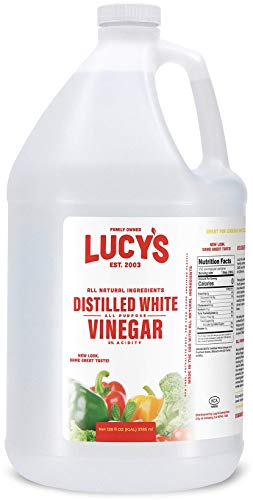
LUCY’S NATURAL COMPOSITION - Lucy’s White Vinegar's reputation as a trusted product stems from its safety, effectiveness, versatility, and eco-friendliness. Made from fermented ethanol, it contains acetic acid, a naturally occurring compound. Its formulation allows it to be used around food and the home. Additionally, white vinegar is biodegradable and does not contribute to environmental pollution, offering a more sustainable cleaning option by reducing reliance from other cleaning agents.
The Vinegar Soak: A Slower Option for Small Parts
White household vinegar commonly contains about 5% acetic acid. It is easier to handle than industrial mineral acids, but it can still irritate skin and eyes and can attack zinc while releasing gas.
Use a compatible, stable plastic container in a ventilated area away from ignition sources. Place the removable part in the container and add enough vinegar to cover only the area that needs stripping. Keep the container open to ventilation and protected from tipping.
Reaction time varies widely. Thin zinc plating may begin reacting relatively quickly, while a thick hot-dip coating can require several hours or an overnight soak. Temperature, vinegar concentration, coating thickness, surface condition, and part geometry all affect the result.
Check the part regularly instead of relying on a fixed time. Brush away loosened residue with a dedicated non-sparking or suitable hand tool, rinse thoroughly, and dry the steel immediately to reduce flash rust. Inspect threads and recesses under good light.
Vinegar is relatively low cost and forgiving, but it is not fume-free, gas-free, or guaranteed to strip every coating evenly. Remaining zinc can still vaporize during welding and contribute to defects.
Why Muriatic Acid Is Not a Casual DIY Method
Muriatic acid is a commercial form of hydrochloric acid. It can attack zinc rapidly, but products vary in concentration and additives. A universal 10% or 20% mixture, or a one-part-acid-to-four-parts-water recipe, is not a reliable procedure.
Do not improvise a dilution or add water and acid based on an internet formula. A professional process must follow the exact product label, safety data sheet, compatibility information, ventilation design, emergency plan, and written shop procedure.
The reaction between zinc and hydrochloric acid can release flammable hydrogen. Keep flames, welding arcs, grinders, switches that may spark, and other ignition sources away from the stripping area.
NIOSH identifies hydrogen chloride and hydrochloric acid as hazardous to the eyes, skin, and respiratory system and notes its reactivity with zinc. Professional handling may require chemical-resistant clothing, gloves, eye and face protection, emergency washing facilities, engineered ventilation, and chemical-specific respiratory protection.
Strong-acid stripping can also pit steel and may create hydrogen-embrittlement concerns in susceptible high-strength parts. Do not acid-strip structural or high-strength fasteners without approval from the manufacturer or responsible engineer.
Why Nitric and Phosphoric Acids Need Professional Control
Nitric acid should not be recommended as a home zinc stripper. It is a strong oxidizer and corrosive liquid. Its vapors and reaction products can seriously damage the respiratory system.
NIOSH lists nitric acid as capable of causing severe irritation, pneumonitis, bronchitis, and delayed pulmonary edema. Do not use a generic one-to-one dilution or casual brush-on instructions.
Phosphoric-acid products are used in some industrial metal-preparation processes, but they still require product-specific controls. A trained person must define the product, concentration, exposure controls, reaction time, rinsing, neutralization when specified, inspection, and disposal method.
For detailed, threaded, valuable, or safety-critical parts, outsource strong-acid stripping or choose a mechanical method when the material and geometry allow it.
Step-by-Step: How to Remove Zinc Coating Safely at Home
For most small welding jobs, use mechanical removal first. Reserve vinegar for removable parts or recesses that cannot be reached safely with an abrasive. Do not move directly from chemical stripping to welding without complete rinsing, drying, inspection, and separation from the stripping area.
- Identify the material and coating: Confirm that the part is galvanized or zinc-plated steel. Stop if the coating, base metal, previous paint, or repair material is unknown.
- Check the job requirements: Review the drawing, manufacturer instructions, welding procedure, applicable code, and inspection requirements. Outsource structural, pressure, confined-space, and other safety-critical work when appropriate.
- Prepare the workspace: Secure the part, remove combustibles, install extraction, separate chemical work from hot work, and arrange controlled cleanup. Wear eye protection, hearing protection, gloves, suitable clothing, and task-specific PPE.
- Mark the heated area: Mark the weld zone and the surrounding area expected to receive significant heat. Include both sides of the joint when both sides will be heated. Do not assume a fixed two-inch clearance fits every joint.
- Remove the coating mechanically: Grind or blast until continuous clean base metal is visible throughout the preparation area. Use light pressure and avoid thinning the steel.
- Use vinegar only when suitable: For a small removable part, vinegar may help loosen zinc in threads or recesses. Keep the process ventilated and away from ignition. Inspect repeatedly rather than relying on a universal soak time.
- Inspect, rinse, and dry: A shiny surface, file stroke, or magnet test does not prove complete removal. Inspect the full area under good light. For critical work, use the coating test or thickness measurement required by the procedure.
- Clean without chlorinated solvent: Use a residue-free, nonchlorinated cleaner that the manufacturer approves for weld preparation, then allow it to dry completely.
- Weld under the correct procedure: Use the specified process, filler metal, shielding gas, joint details, polarity, and settings. Test on matching scrap when the procedure permits.
- Inspect and restore protection: Allow the weld to cool, complete the required inspection, remove suitable residue, and repair the damaged corrosion protection according to the project specification.
Warning: Never clean a weld area with chlorinated brake cleaner, chlorinated degreaser, or an unidentified solvent. OSHA notes that chlorinated hydrocarbon residue can form hazardous decomposition products when heated, and phosgene can be produced near welding under some conditions.
Job time varies with part size, coating thickness, access, surface geometry, and the chosen method. Large frames, structural pieces, and parts requiring complete coating removal are often safer and faster to send to a blasting or fabrication shop.
Pros and Cons of Zinc Removal Methods
| Method | Pros | Cons | Best For | Typical Time |
|---|---|---|---|---|
| Grinding | Fast, precise, and free of liquid chemicals | Creates zinc dust and noise; can gouge or thin steel | Local weld zones and small repairs | Often minutes for a small area; coating-dependent |
| Torch Heating | No routine DIY advantage | Creates zinc fume, fire risk, scale, and distortion | Only an engineered industrial procedure | Not recommended for DIY stripping |
| Abrasive Blasting | Uniform removal across large or complex surfaces | Requires equipment, containment, PPE, and media disposal | Frames, beams, recessed areas, and batches | Varies by setup, profile, and surface area |
| Vinegar Soak | Low cost and relatively mild | Slow, may strip unevenly, and can release hydrogen | Small removable parts and recesses | Often several hours; thick coatings may take overnight or longer |
| Muriatic Acid | Rapid in a controlled professional process | Severe burn, inhalation, hydrogen, corrosion, and waste hazards | Trained professional shop use | Product- and process-specific |
| Nitric or Phosphoric Acid | Can reach detailed surfaces in engineered processes | Serious chemical, reaction, and respiratory hazards | Professional product-specific processes | Product- and process-specific |
No single method fits every part. Grinding is usually the practical local option, blasting suits larger surfaces, and vinegar may suit small removable pieces. Torch removal and strong-acid stripping require controls that are normally outside casual DIY work.
Preparing the Weld After Removing the Zinc
Once the coating is gone, treat the preparation area as bare steel. Remove abrasive residue and chemical contamination, verify the joint dimensions, and follow the correct welding procedure before striking an arc.
Avoid Chlorinated Cleaners
Use only a cleaner that is nonchlorinated, residue-free, compatible with the base metal, and approved for welding preparation. Keep all cleaning and spraying operations away from the active welding area.
OSHA’s welding-chemical guidance explains that residues from chlorinated degreasers can form dangerous decomposition products when heated. Do not rely on evaporation alone when the identity of a previous cleaner is unknown.
Joint Preparation and Filler Metal
A 30- to 45-degree bevel may suit some V-groove procedures, but the correct bevel angle, root face, root opening, and backing arrangement depend on material thickness, process, position, loading, and the governing specification.
ER70S-6 wire in 0.035-inch diameter and E70XX electrodes such as 7018 are common mild-steel consumables, but they are not universal prescriptions. Match the filler metal to the identified base steel and the approved procedure.
A36 steel often uses compatible mild-steel filler, but structural work should follow the applicable welding procedure and code. When AWS D1.1 or another code governs the project, coating removal, qualification, preheat, filler selection, and inspection must follow the approved documents.
Welding Settings After Zinc Removal
Do not publish or copy one machine setting as correct for every joint. Example values such as 18–20 volts, 150–200 inches per minute of wire feed, or an estimated 120–140 amps on a Miller Multimatic 215 may suit certain wire, gas, joint, and plate combinations, but they are not a universal prescription for 1/4-inch steel.
Wire diameter, electrode classification, shielding gas, polarity, joint design, position, stickout, transfer mode, and machine calibration all affect the result. Use the machine chart, consumable data, approved procedure, and a test on matching scrap when permitted.
Do not automatically add two voltage points when changing to flux-cored wire. Do not preheat to 150°F unless the material, thickness, restraint, hydrogen control, ambient conditions, or approved procedure requires it.
Control Fume During Welding
Removing visible zinc reduces the coating heated directly by the arc, but zinc can remain near the edge of the prepared area or on the opposite side. Position local exhaust to capture the plume without pulling away shielding gas or disturbing the process.
Keep your head out of the plume. Do not place your face above the joint, inside a frame, or in a path where rising fume will pass through the helmet. Reposition the work, your body, or the extraction nozzle when the plume changes direction.
Common Zinc-Removal Mistakes and Their Fixes
Skipping ventilation: A garage door, open bay, fan, or outdoor location may still leave the plume in your breathing zone. Put local exhaust near the source and verify that it pulls fume away from you and other people.
Treating a filter rating as the whole respirator decision: An N95 or P100 designation describes particulate filtration performance under test conditions. It does not establish that the device is suitable for the concentration, gases, vapors, oxygen level, facial fit, or complete task. Use hazard-based selection and required fit testing.
Using chlorinated brake cleaner: Do not use it on or near metal that will be welded or heated. Stop if you cannot identify a cleaner previously used on the part.
Overusing acid: Excess exposure can pit steel, alter threads, increase flash rust, and create waste problems. Follow the product-specific procedure for rinsing, neutralization when specified, drying, and disposal.
Leaving zinc behind: Residual coating can vaporize beneath the weld pool and contribute to porosity. Inspect the entire heated area, including edges and the opposite side. A smooth file stroke or magnet test does not prove full removal.
Rushing a vinegar soak: Thick or alloyed coatings can take much longer than expected. Brush, rinse, inspect, and repeat only when the part remains suitable for the process.
Grinding too hot: Long, heavy passes can warp sheet metal and thin the edge. Use short passes, light pressure, and cooling time between passes.
Removing too much base metal: Stop when the coating is gone. Repair or reject gouged material according to the project requirements instead of hiding damage under the weld.
Ignoring cleanup: Collect dust and spent abrasive with controlled methods. Do not blow zinc residue into the air, wash it into a storm drain, or mix unidentified chemical waste with ordinary household waste.
Real-World Method Choices
For a DIY fire pit, vinegar may help with small removable legs or fasteners, followed by controlled grinding at the actual joint. Do not treat 16 volts as a universal MIG setting. Use the machine chart and matching test material.
For a trailer frame, grind or professionally blast the weld zones instead of burning off the coating. E71T-1 flux-cored wire is suitable only when its complete classification, shielding requirements, position limits, base material, and procedure match the repair.
For a structural beam, abrasive blasting may prepare a broad area efficiently. A 7018 electrode at 160 amps may fit certain electrode diameters and positions, but AWS does not assign one current to every 7018 weld. Follow the approved welding procedure specification.
For a supervised student project, vinegar can demonstrate careful surface preparation without introducing a strong mineral acid. The instructor still needs ventilation, eye protection, gloves, stable containers, ignition control, waste handling, and a separate hot-work area.
For pipeline work, do not assume muriatic acid is the correct treatment for every fitting. API 1104 work depends on a qualified procedure, material control, project specifications, and the owner’s coating-removal and restoration requirements.
For bolts and nuts, remember that removing zinc reduces corrosion protection and may change dimensions or thread fit. Do not strip structural, heat-treated, or high-strength fasteners without manufacturer or engineering approval.
The right method depends on the part, coating, code, shop controls, and required finish. A process that is acceptable for a small noncritical bracket may be unsafe or prohibited on a load-bearing structure.
Final Checklist: Remove Zinc, Control Fume, Restore Protection
- Confirm the base metal, coating, and project requirements.
- Choose grinding for most local repairs, blasting for larger surfaces, or vinegar for suitable removable parts.
- Do not burn zinc off with a torch.
- Leave strong-acid stripping to a controlled professional process.
- Remove zinc from the complete weld and heat-affected area, including the opposite side when necessary.
- Capture grinding dust and welding fume near the source.
- Use respiratory protection only after proper hazard-based selection.
- Never use chlorinated brake cleaner or unidentified solvent near welding.
- Confirm clean bare steel and correct joint dimensions.
- Use the filler metal and settings required by the procedure.
- Inspect the weld before applying a repair coating.
- Collect and dispose of dust, media, and stripping waste under applicable local rules.
After the weld cools and passes inspection, restore corrosion protection with the system required by the project. The American Galvanizers Association’s repair guidance explains that ASTM A780 covers recognized methods for repairing damaged and uncoated areas of hot-dip galvanized coatings.
Depending on the specification, repair options may include zinc-rich paint, zinc-based solder, or sprayed zinc. A product marketed as “cold galvanizing” is not automatically equivalent to a new hot-dip galvanized coating. Follow surface-preparation, film-thickness, curing, inspection, and compatibility requirements for the selected repair system.
Frequently Asked Questions
Can I weld galvanized steel without removing the coating?
Some qualified industrial procedures allow welding through galvanizing, but the coating can increase fume, spatter, porosity, and process variability. Removing zinc from the heated joint area normally improves control. Whether the coating is removed or not, use effective fume controls and follow the approved procedure.
Is vinegar effective for removing zinc from thick galvanized steel?
Vinegar can attack zinc, but thick hot-dip coatings may need many hours or longer. Check the part regularly, brush away loosened residue, rinse, dry, and inspect the entire area. Grinding or professional blasting is usually more practical for large or heavily coated pieces.
What safety gear do I need for chemical zinc stripping?
The required equipment depends on the exact chemical, concentration, process, and exposure. Follow the safety data sheet for compatible gloves, clothing, eye and face protection, ventilation, emergency washing, and respiratory protection. Do not use a generic PPE list for strong acids.
How do I know if I have removed all the zinc coating?
Inspect the full weld and heat-affected area under bright light, including edges, recesses, and the opposite side. Do not rely only on color, shine, a file, or a magnet. Critical work may require a coating-thickness gauge or another documented inspection method.
What is the best method for removing zinc from bolts and nuts?
Vinegar is a practical home option for ordinary small removable fasteners because it can reach threads. Brush, rinse, and dry the parts after soaking. Do not strip structural, high-strength, heat-treated, or manufacturer-specified fasteners without approval because coating removal can affect corrosion protection and fit.
How far from the weld should I remove the zinc?
There is no universal distance. Remove the coating from the weld area and the surrounding zone that the procedure expects to receive enough heat to melt or vaporize zinc. Coating thickness, material thickness, joint design, process, heat input, and access all affect the required clearance.
Can I grind galvanized steel indoors?
Only when the work area has effective source extraction, containment, controlled cleanup, and suitable PPE. An open door or ordinary room fan may spread zinc-containing dust rather than capture it. If you cannot control airborne dust and protect other occupants, move the job to a properly equipped shop.
Sources
- OSHA: Controlling Hazardous Fume and Gases During Welding — ventilation, work practices, and respiratory-control principles
- OSHA: Chemicals in Welding, Cutting, and Brazing — coating, cleaner, and chlorinated-solvent decomposition hazards
- OSHA: Respiratory Protection Standard — respirator selection, medical evaluation, fit testing, and program requirements
- NIOSH Pocket Guide: Zinc Oxide — zinc oxide exposure routes and metal fume fever symptoms
- NIOSH Pocket Guide: Hydrogen Chloride — hydrochloric acid hazards and reactivity with zinc
- American Galvanizers Association: Repairing Hot-Dip Galvanized Steel — ASTM A780-based corrosion-coating repair methods